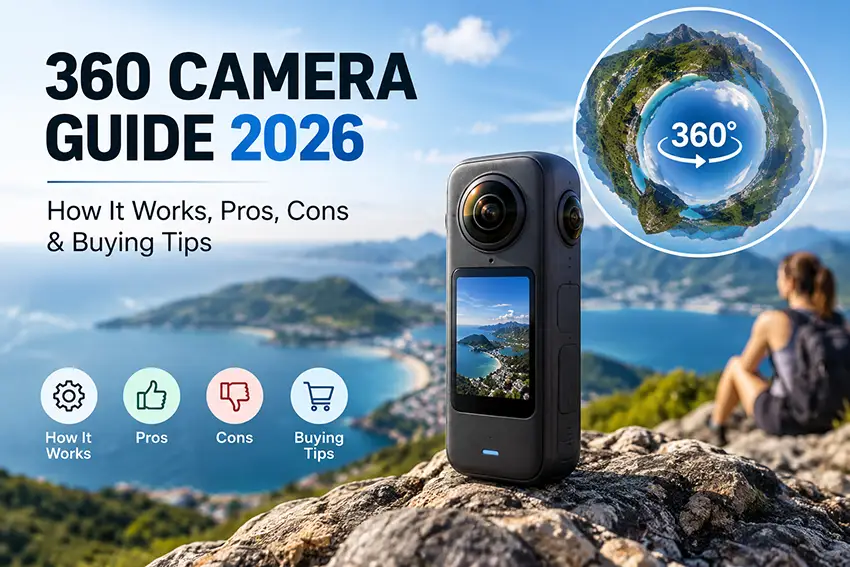
360 Camera Guide 2026: How It Works, Pros, Cons & Buying Tips
A 360 camera captures nearly everything around the camera at the same time, allowing you to create immersive photos and videos without pointing a traditional camera in one specific direction.
This makes 360 cameras useful for travel, action sports, virtual tours, real estate, social media, training, events, and creative video production.
But they are not the best choice for every situation.
In this guide, we explain how a 360 camera works, its main advantages and disadvantages, and what to check before buying one.
What Is a 360 Camera?
A 360 camera is a camera designed to capture a complete or nearly complete view of its surroundings.
Most consumer 360 cameras use two ultra-wide-angle lenses positioned on opposite sides of the camera.
Each lens captures part of the scene. The camera’s software then combines—or “stitches”—the two images into a single spherical photo or video.
The result allows viewers to look in different directions rather than seeing only the direction originally chosen by the camera operator.
How Does a 360 Camera Work?
A typical 360 camera uses two main steps.
1. Capture
Two wide-angle lenses record overlapping views around the camera.
Because each lens covers a very wide field of view, together they can capture almost the entire environment.
2. Stitching
Software combines the images from both lenses.
Good stitching software attempts to hide the boundary between the two images and create one continuous view.
Modern cameras can often perform much of this process automatically through their mobile or desktop applications.
Advantages of a 360 Camera
Capture First, Frame Later
One of the biggest advantages is the ability to choose your composition after recording.
With a traditional camera, you have to point the lens toward the subject while filming.
With a 360 camera, you can record the complete scene and later choose which direction viewers see in a conventional video.
This technique is often called reframing.
Useful for Action and Travel
When skiing, cycling, hiking, driving, or traveling, it can be difficult to keep a normal camera pointed at the most interesting part of the scene.
A 360 camera reduces this problem because it records multiple directions simultaneously.
Creative Camera Angles
Many 360 cameras can create perspectives that would otherwise require complicated camera rigs.
When used with a compatible selfie stick, software may also hide much of the stick from the final image, creating a floating-camera effect.
Virtual Tours
360 photography is useful for showing spaces such as:
- homes and apartments;
- hotels;
- restaurants;
- offices;
- stores;
- tourist destinations.
A viewer can explore more of the environment than with a standard photograph.
Good for Social Media Content
A single 360 recording can potentially be reframed into multiple traditional clips.
This gives content creators more flexibility when producing vertical, horizontal, and short-form content.
Disadvantages of 360 Cameras
360 cameras also have important limitations.
Vulnerable Lenses
The lenses usually extend outward from the body of the camera.
This helps them capture a wide field of view, but also makes them easier to scratch or damage.
A damaged 360 lens can have a noticeable effect on image quality.
Lens guards and a protective case can therefore be worthwhile.
Resolution Is Spread Across a Larger Image
A specification such as 5.7K or 8K may sound extremely high.
However, a 360 camera spreads those pixels across the entire spherical image.
When you crop or reframe only one part of that sphere, the final visible image may contain much less detail than expected from the headline resolution.
For this reason, you should not compare a 360 camera’s resolution directly with a traditional camera using resolution alone.
Low-Light Performance Can Be Challenging
Small camera sensors and very wide lenses can make low-light situations difficult.
Image noise, motion blur, and loss of detail may become more noticeable at night or indoors.
If low-light recording is important to you, sensor size and image processing deserve particular attention.
Stitching Artifacts
Because footage from multiple lenses must be combined, objects positioned close to the stitching boundary can sometimes appear distorted or partially disappear.
Keeping important subjects slightly farther away from the camera can improve results.
More Editing
360 footage gives creators more freedom, but that freedom often requires additional editing.
Reframing, tracking subjects, selecting angles, exporting, and managing larger files can take more time than working with conventional video.
Large File Sizes
High-resolution 360 video can consume considerable storage.
Long recording sessions may require additional memory cards, phone storage, computer storage, and backup capacity.
How to Choose a 360 Camera
Before buying, compare cameras using the following criteria.
1. Video Quality
Do not evaluate a 360 camera using resolution alone.
Look at:
- effective detail after reframing;
- dynamic range;
- color;
- low-light performance;
- frame-rate options;
- stabilization.
If possible, examine actual exported footage rather than relying only on specifications.
2. Stabilization
Stabilization is particularly important for walking, cycling, skiing, motorcycles, travel, and handheld recording.
Good stabilization can make footage much easier to watch.
3. Lens Protection
Check whether the camera supports replaceable or removable lens guards.
For action use, this can be one of the most important practical considerations.
4. Battery Life
Consider how long the camera can record at the resolution and frame rate you actually intend to use.
Higher recording settings generally place greater demands on the battery.
For longer trips, removable batteries or portable charging may be useful.
5. Waterproofing
Do not assume every 360 camera can be submerged without additional protection.
Check the manufacturer’s stated water-resistance or waterproof rating before using a camera around water.
6. Editing Software
Software quality can be just as important as camera hardware.
A good app should make it easy to:
- reframe video;
- track subjects;
- change aspect ratios;
- export clips;
- apply stabilization;
- transfer footage.
7. Storage Requirements
Check supported memory card capacity and recommended card speed.
High-resolution recording requires fast storage and can produce large files.
8. Audio
Built-in microphones can be convenient, but users who need high-quality speech or professional audio should also investigate external microphone support.
Which Type of 360 Camera Should You Choose?
For Travel
Prioritize portability, battery life, stabilization, reliable mobile editing, and lens protection.
For Action Sports
Prioritize strong stabilization, water resistance, rugged accessories, secure mounting, and replaceable lens protection.
For Virtual Tours
Prioritize image quality, high-resolution still photography, consistent exposure, and workflow compatibility.
For Social Media
Prioritize fast mobile editing, subject tracking, vertical export, and easy reframing.
For Professional Production
Prioritize sensor performance, manual controls, high-quality recording formats, audio options, and desktop editing support.
360 Camera vs Action Camera
Choose a traditional action camera when you already know exactly what direction you want to film and want a straightforward workflow.
Choose a 360 camera when capturing everything around the camera and selecting the framing later would be more useful.
Some creators use both.
Is a 360 Camera Worth It?
A 360 camera can be worth buying if its unique strengths solve a real problem for you.
It is particularly useful when you:
- frequently miss shots because the camera is pointing in the wrong direction;
- want unusual third-person perspectives;
- create travel or action videos;
- need virtual-tour content;
- want to create multiple compositions from one recording.
It may be less suitable if you mainly want conventional photography, maximum low-light quality, minimal editing, or the simplest possible workflow.
Frequently Asked Questions
Does a 360 camera actually record everything?
Most consumer models record nearly the complete environment around the camera by combining footage from two or more wide-angle lenses. Small blind spots can remain around the camera body.
Can you make normal videos with a 360 camera?
Yes. You can capture 360-degree footage and then reframe part of the recording into a normal flat video.
Why do 360 camera lenses scratch easily?
The lenses often protrude from the body so they can capture a very wide field of view. That exposed design also makes them more vulnerable to contact and scratches.
Is higher resolution always better?
Not necessarily. Resolution is only one factor. Sensor performance, lens quality, stabilization, stitching, processing, and the amount of cropping used during reframing also affect the final image.
Are 360 cameras good for beginners?
They can be. Automatic stitching and mobile apps have made them easier to use, although editing 360 footage usually requires learning a slightly different workflow.
Final Buying Advice
The best 360 camera is not necessarily the model with the largest resolution number.
Start by deciding how you plan to use it.
Then compare image quality, stabilization, lens protection, battery life, waterproofing, editing software, and storage requirements.
For many buyers, software quality and ease of editing are just as important as the camera hardware itself.