
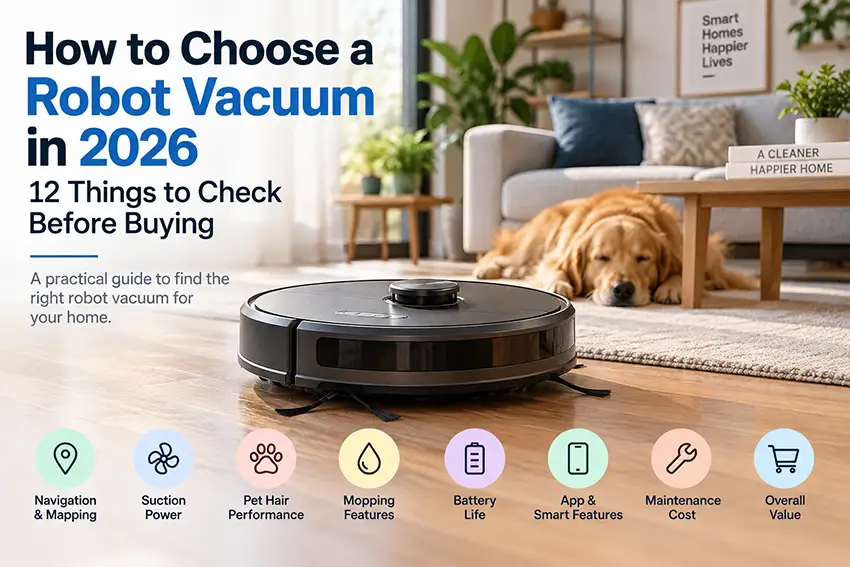
How to Choose a Robot Vacuum in 2026: 12 Things to Check Before Buying
A good robot vacuum can reduce the amount of daily floor cleaning you need to do, but choosing the wrong model can leave you dealing with tangled hair, poor navigation, missed rooms, weak carpet cleaning, and constant maintenance.
The best robot vacuum for you depends less on the longest specification list and more on your home.
Before buying, consider your flooring, pets, floor plan, furniture, cleaning expectations, and how much maintenance you want to do yourself.
Here are the most important factors to check.
1. Start With Your Flooring
The first question is what your robot will actually clean.
Mostly Hard Floors
For tile, laminate, vinyl, and similar surfaces, extremely high suction may not be the most important factor.
Good navigation, edge cleaning, obstacle detection, and mopping performance may matter more.
Mostly Carpet
For homes with carpet, look for strong pickup performance and a brush system designed to remove dirt from carpet fibers.
If the robot also mops, check whether it can automatically avoid or lift the mop when it detects carpet.
Mixed Flooring
For homes with both hard floors and carpet, choose a robot capable of adjusting its cleaning behavior between surfaces.
2. Navigation and Mapping
Navigation is one of the biggest differences between basic and more advanced robot vacuums.
Budget models may move using simple sensors and less systematic cleaning patterns.
More advanced robots can build a map of your home and clean rooms in a more organized way.
Mapping features can include:
- room recognition;
- room-by-room cleaning;
- no-go zones;
- cleaning zones;
- multiple-floor maps;
- automatic route planning.
For larger or more complicated homes, accurate mapping is usually worth prioritizing.
3. LiDAR vs Camera Navigation
Two common technologies are LiDAR and camera-based navigation.
LiDAR
LiDAR measures distances using laser-based sensors and can create detailed maps.
It can often navigate effectively even when the room is relatively dark.
Camera-Based Navigation
Camera systems use visual information to understand the environment.
Some advanced systems can also identify objects such as shoes, cables, or other obstacles.
Neither technology should be judged by its name alone.
The quality of the software and obstacle-avoidance system is equally important.
4. Obstacle Avoidance
Traditional robot vacuums may recognize walls and furniture but still become trapped by smaller objects.
If your floors frequently contain:
- charging cables;
- shoes;
- toys;
- pet bowls;
- socks;
- small objects,
advanced obstacle detection can significantly reduce how often you need to rescue the robot.
No obstacle-avoidance system is perfect, so floors should still be kept reasonably clear.
5. Suction Power
Suction figures are frequently used in robot-vacuum marketing, but they should not be your only comparison point.
Actual cleaning performance also depends on:
- airflow;
- brush design;
- floor contact;
- navigation;
- cleaning pattern;
- automatic suction adjustment.
A robot with a larger advertised Pa number is not automatically a better cleaner.
Use suction specifications as one factor rather than the entire buying decision.
6. Brush Design and Pet Hair
Pet owners should pay particular attention to the brush system.
Hair can wrap around traditional brush rollers and require frequent manual cleaning.
Some robots use rubber rollers or anti-tangle designs to reduce this problem.
If you have dogs or cats, investigate:
- hair pickup on your type of floor;
- brush tangling;
- edge cleaning;
- dustbin capacity;
- automatic emptying.
7. Self-Emptying Dock
A self-emptying station transfers dirt from the robot’s small internal dustbin into a larger bag or container in the base station.
This can reduce how frequently you manually empty the robot.
It is useful for:
- pet owners;
- larger homes;
- people with allergies;
- users who want less routine maintenance.
However, self-emptying bases are larger, more expensive, and still require periodic maintenance.
8. Mopping
Robot mopping systems vary considerably.
Basic models may simply drag a damp pad across the floor.
More advanced systems can offer:
- controlled water flow;
- rotating or vibrating mop pads;
- automatic mop lifting;
- mop washing;
- mop drying;
- dirt detection.
If mopping is important to you, do not assume every vacuum-and-mop model performs equally well.
For homes with carpet, automatic mop lifting or reliable carpet avoidance is particularly useful.
9. Battery Life
Battery requirements depend largely on the size of your home.
For a small apartment, battery capacity may not be a major concern.
For larger homes, look for a robot that can automatically:
- return to its charging dock;
- recharge;
- resume cleaning where it stopped.
This feature is often more useful than comparing battery-capacity numbers alone.
10. Robot Height
A robot vacuum cannot clean under furniture if it does not fit.
Before buying, measure the clearance underneath important furniture such as:
- beds;
- sofas;
- cabinets;
- tables.
Then compare those measurements with the robot’s height.
Models with raised navigation sensors may require additional clearance.
11. App and Smart Features
A useful app should do more than simply start and stop the robot.
Look for features such as:
- room selection;
- scheduled cleaning;
- suction settings;
- map editing;
- no-go zones;
- cleaning history;
- maintenance reminders;
- multi-floor maps.
Voice-assistant support can be convenient, but mapping and cleaning controls generally have a larger impact on day-to-day use.
12. Maintenance Cost
The purchase price is not the complete cost of a robot vacuum.
Consumable or replaceable components may include:
- dust bags;
- filters;
- side brushes;
- main rollers;
- mop pads;
- cleaning solution;
- replacement batteries.
Before buying, check the availability and cost of replacement parts.
A cheaper robot can become expensive if compatible consumables are difficult to find.
Which Robot Vacuum Is Right for You?
Small Apartment
Prioritize:
- compact charging dock;
- good navigation;
- low noise;
- reliable hard-floor cleaning.
A large self-emptying station may not be necessary.
Large Home
Prioritize:
- mapping;
- recharge and resume;
- efficient navigation;
- self-emptying;
- large cleaning coverage.
Home With Pets
Prioritize:
- strong hair pickup;
- anti-tangle rollers;
- larger dust capacity;
- self-emptying;
- good obstacle avoidance.
Mostly Carpet
Prioritize:
- proven carpet cleaning;
- effective brush design;
- automatic suction adjustment;
- carpet-safe mopping behavior.
Mostly Hard Flooring
Prioritize:
- edge cleaning;
- navigation;
- mopping quality;
- obstacle avoidance.
Features Worth Paying More For
For many households, these upgrades can have a meaningful practical benefit:
- accurate room mapping;
- obstacle avoidance;
- self-emptying;
- mop lifting for carpet;
- recharge and resume;
- anti-tangle brush systems.
By contrast, a feature that looks impressive on a specification sheet may provide little value if it does not match your home.
Common Robot Vacuum Buying Mistakes
Choosing by Suction Number Alone
A large Pa number does not guarantee superior real-world cleaning.
Ignoring the Dock Size
Premium docking stations can take up considerable floor space.
Check dimensions before purchasing.
Forgetting Replacement Parts
Check consumable availability before committing to a model.
Buying a Mop Feature You Will Not Use
A vacuum-and-mop robot only provides extra value if its mopping system fits your flooring and cleaning habits.
Ignoring Furniture Clearance
Always measure low furniture before buying.
Robot Vacuum Buying Checklist
Before purchasing, answer these questions:
- What type of floors do I have?
- Do I have pets?
- Do I need mopping?
- Do I want a self-emptying station?
- How complicated is my floor plan?
- Are cables or small objects frequently left on the floor?
- Does the robot fit under my furniture?
- Are replacement parts easy to buy?
- Does the app support room and zone cleaning?
- Can it recharge and resume automatically?
- How much maintenance am I willing to do?
- Does the total price fit my budget?
If you can answer these questions, choosing the right robot vacuum becomes much easier.
Frequently Asked Questions
What should I look for when buying a robot vacuum?
Start with navigation quality, cleaning performance on your floor type, brush design, obstacle avoidance, battery management, maintenance requirements, and replacement-part availability.
Is LiDAR necessary for a robot vacuum?
Not always. It can be useful for reliable mapping and navigation, especially in larger homes, but the overall navigation software matters as much as the sensor technology.
Are self-emptying robot vacuums worth it?
They can be particularly useful in larger homes and homes with pets because they reduce how frequently the robot’s internal bin needs to be emptied.
Do robot vacuums work on carpet?
Many do, but performance varies considerably. Check carpet cleaning, brush design, and how the robot handles carpet when mopping.
How long does a robot vacuum last?
Service life depends on build quality, frequency of use, maintenance, battery condition, and whether replacement parts remain available.
Final Advice
Do not choose a robot vacuum by looking for the longest feature list.
Choose one that fits your flooring, floor plan, pets, furniture, and preferred level of maintenance.
Reliable navigation and cleaning performance are usually more valuable than features you rarely use.
360-Degree Camera : A Comprehensive Guide for Better Marketing and Sales